A comprehensive exploration of the Twelve Great Feasts (Dodekaorton) — the most important celebrations in the Orthodox liturgical calendar and among the most beloved subjects in Byzantine iconography.
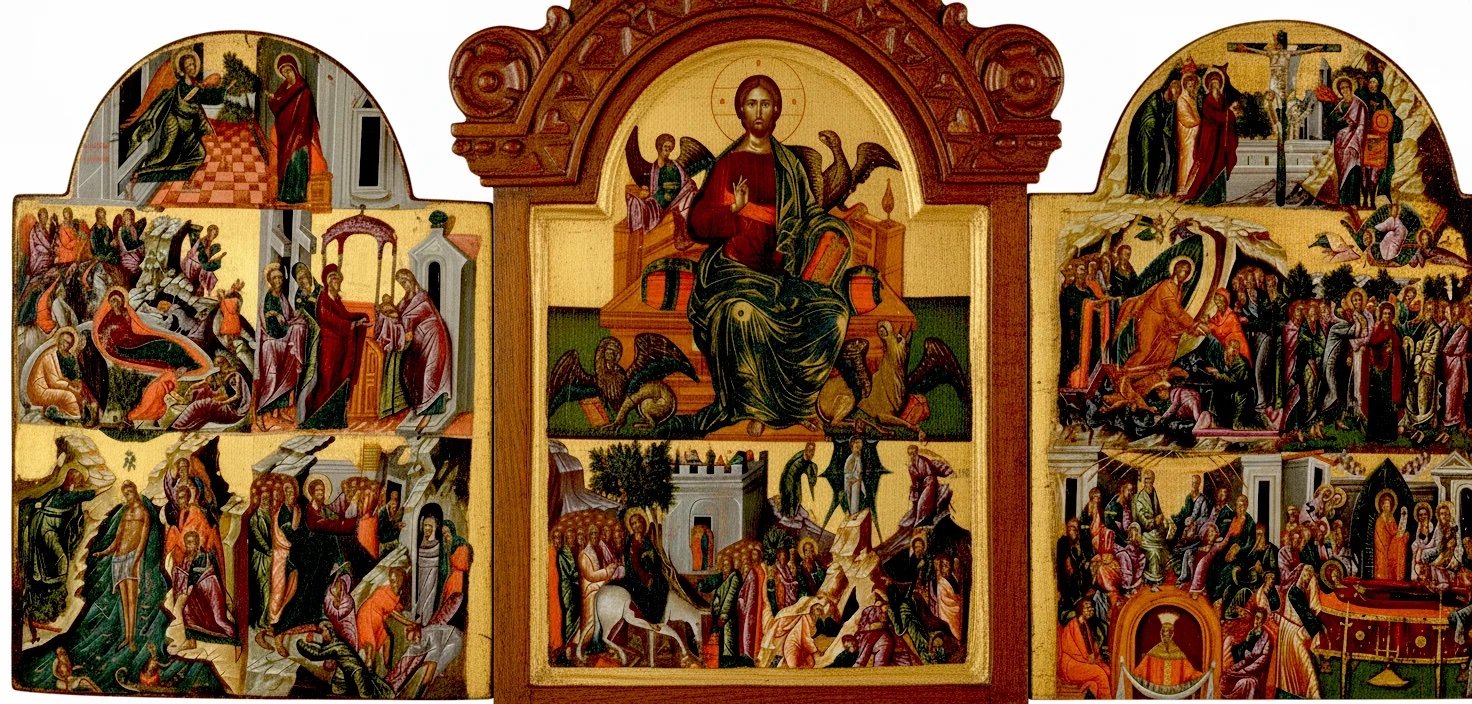
Triptych of the Twelve Feasts with Christ Enthroned at center — a magnificent example of Dodekaorton composition
Introduction
The Twelve Great Feasts (Greek: Δωδεκάορτον, Dodekaorton) represent the pinnacle of the Orthodox liturgical year. These twelve celebrations commemorate the most significant events in the lives of Christ and the Theotokos, forming the theological backbone of Orthodox Christianity.
In Byzantine iconography, the Great Feasts are depicted as individual icons or combined into magnificent multi-scene compositions. Understanding these feasts deepens appreciation for both the liturgical tradition and the sacred art that illuminates it.
The Liturgical Calendar
The Orthodox liturgical year begins on September 1st. The Twelve Great Feasts are divided into two categories:
Feasts of the Lord (Despotic Feasts)
Eight feasts directly commemorating events in Christ's life:
- Nativity of Christ
- Theophany (Baptism)
- Presentation of Christ (Hypapante)
- Transfiguration
- Palm Sunday (Entry into Jerusalem)
- Ascension
- Pentecost
- Exaltation of the Cross
Feasts of the Theotokos
Four feasts honoring the Virgin Mary:
- Nativity of the Theotokos
- Presentation of the Theotokos
- Annunciation
- Dormition
The Twelve Feasts Explained
1. Nativity of the Theotokos (September 8)
Event: The birth of the Virgin Mary to Saints Joachim and Anna after years of childlessness.
Iconographic Elements:
- St. Anna reclining on a bed, attended by midwives
- The infant Mary being bathed or swaddled
- St. Joachim watching from the doorway or garden
- Domestic setting with architectural elements
Theological Significance: The beginning of salvation history — the birth of her who would become the Mother of God.
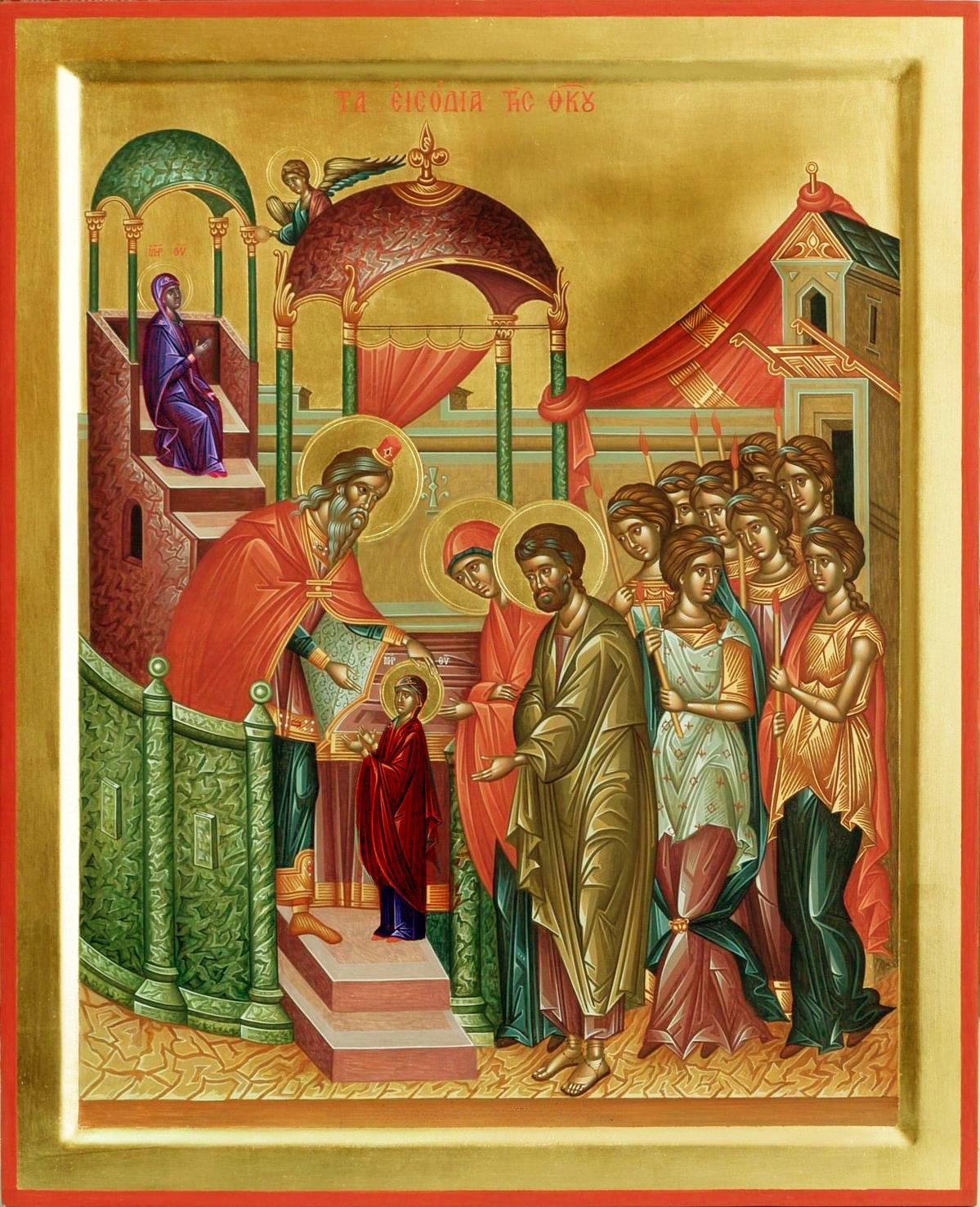

Left: The Presentation of the Theotokos — Right: Detail from a Great Feasts cycle
2. Exaltation of the Holy Cross (September 14)
Event: The discovery of the True Cross by St. Helena and its elevation by Patriarch Macarius in Jerusalem (326 AD).
Iconographic Elements:
- Patriarch elevating the cross on a raised platform
- Crowds of faithful bowing in veneration
- St. Helena and Emperor Constantine present
- Church architecture representing the Holy Sepulchre
Theological Significance: The Cross as the instrument of salvation, worthy of veneration.
3. Presentation of the Theotokos (November 21)
Event: Three-year-old Mary is brought to the Temple by her parents to be dedicated to God's service.
Iconographic Elements:
- The child Mary ascending the Temple steps
- High Priest Zacharias receiving her at the altar
- Joachim and Anna presenting their daughter
- Virgins with candles accompanying the procession
- The Holy of Holies where Mary will dwell
Theological Significance: Mary as the living Temple, prepared from childhood for her divine calling.
4. Nativity of Christ (December 25)
Event: The birth of Jesus Christ in Bethlehem.
Iconographic Elements:
- The Theotokos reclining, turned away from the manger (signifying virgin birth)
- The Christ Child in swaddling clothes, in a cave-manger
- The ox and ass warming the infant
- Angels glorifying God above
- Shepherds receiving the angelic announcement
- The Magi following the star
- Joseph in contemplation (sometimes tempted by a demon-shepherd)
- Midwives bathing the infant
Theological Significance: The Incarnation — God becomes man for our salvation.
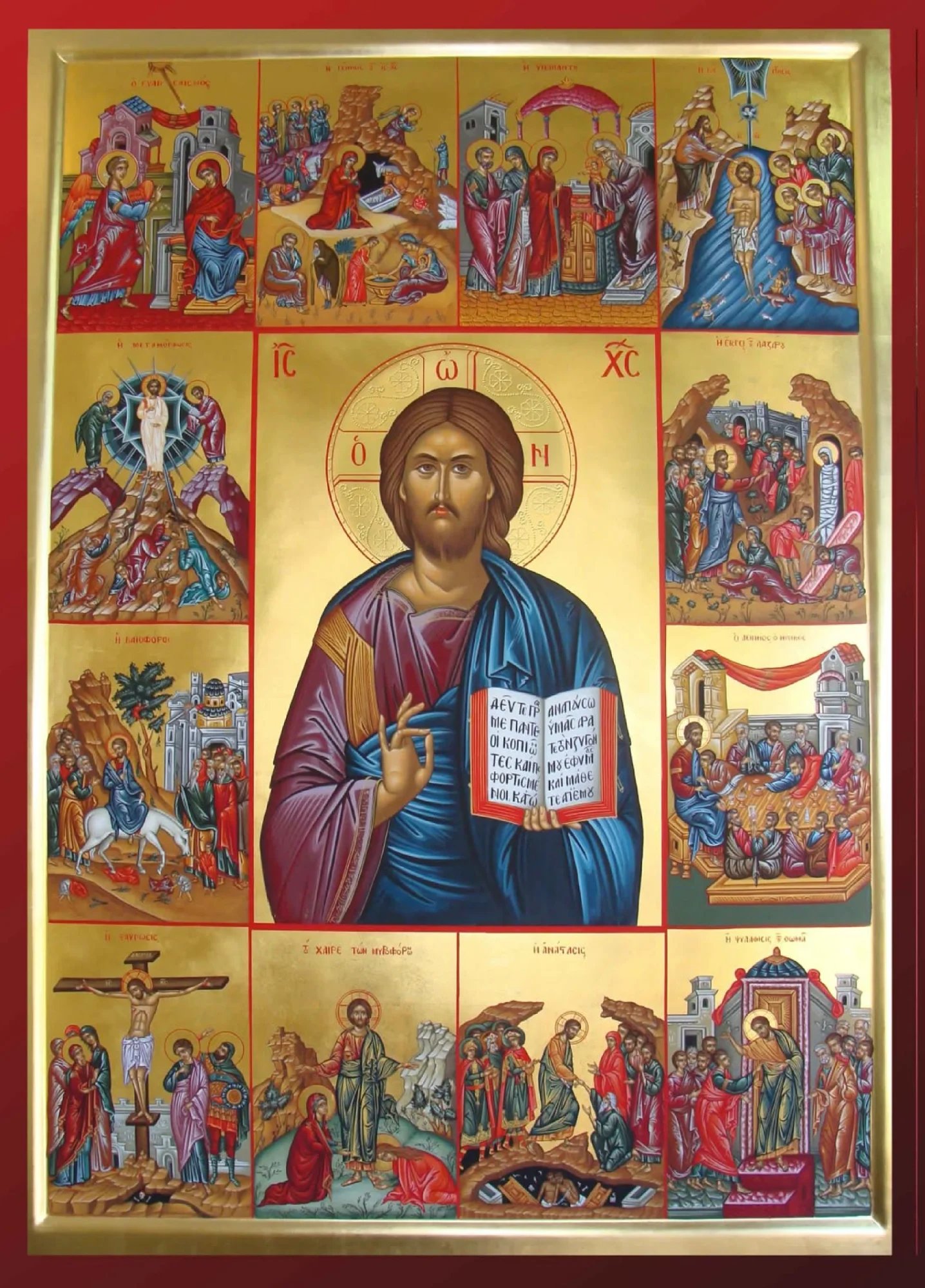
Christ Pantocrator surrounded by scenes from His life — the Twelve Feasts arranged around the central figure
5. Theophany / Baptism of Christ (January 6)
Event: Christ's baptism by John in the Jordan River, revealing the Holy Trinity.
Iconographic Elements:
- Christ standing in the Jordan (often depicted as a cave)
- John the Baptist bowing to baptize Christ
- The Holy Spirit descending as a dove
- Ray of divine light from heaven (sometimes with the Father's hand)
- Angels attending with cloths
- Personifications of the Jordan River and Sea
- Fish and crosses in the water
Theological Significance: The revelation (theophany) of the Trinity; sanctification of water.
6. Presentation of Christ / Hypapante (February 2)
Event: Forty days after birth, Mary and Joseph present Jesus at the Temple.
Iconographic Elements:
- Simeon the Elder receiving the Christ Child
- The Prophetess Anna with a scroll
- The Theotokos presenting or reaching for her Son
- Joseph carrying two doves (the offering of the poor)
- Temple architecture with ciborium
Theological Significance: The meeting (Hypapante) of the Old and New Testaments; Christ is recognized as the Messiah.
7. Annunciation (March 25)
Event: The Archangel Gabriel announces to Mary that she will conceive the Son of God.
Iconographic Elements:
- The Archangel Gabriel in dynamic movement
- The Virgin Mary, often seated with spindle or book
- Divine ray descending upon Mary (the Holy Spirit)
- Architectural setting with a red veil (indicating royalty)
- Gabriel's staff or lily
Theological Significance: The moment of Incarnation; Mary's "yes" enables salvation.
8. Palm Sunday / Entry into Jerusalem
Event: Christ's triumphal entry into Jerusalem before His Passion.
Iconographic Elements:
- Christ riding a donkey (sometimes with a foal)
- Disciples following behind
- Crowds waving palm branches
- Children laying garments on the road
- People in trees to see Christ
- The walls and gates of Jerusalem
Theological Significance: Christ as the humble King; the beginning of Holy Week.
9. Ascension (40 days after Pascha)
Event: Christ ascends to heaven in the presence of His disciples.
Iconographic Elements:
- Christ in a mandorla, borne upward by angels
- The Theotokos at center (the Church)
- The Twelve Apostles on either side, looking upward
- Two angels pointing heavenward
- The Mount of Olives beneath
Theological Significance: Christ's glorification and promise to return; humanity enters heaven.
10. Pentecost (50 days after Pascha)
Event: The descent of the Holy Spirit upon the Apostles.
Iconographic Elements:
- The Apostles seated in a semicircle
- Tongues of fire above each head
- Rays descending from heaven (or a dove)
- An empty throne or space at top (Christ's invisible presence)
- The figure of "Cosmos" below — an old king representing the world receiving the Gospel
- Scrolls representing the languages spoken
Theological Significance: The birth of the Church; the Spirit empowers mission to all nations.
11. Transfiguration (August 6)
Event: Christ reveals His divine glory to Peter, James, and John on Mount Tabor.
Iconographic Elements:
- Christ in brilliant white garments, within a mandorla
- Moses and Elijah conversing with Christ
- Peter, James, and John fallen in awe
- Divine light rays emanating from Christ
- Rocky mountain landscape
Theological Significance: The revelation of Christ's divinity; a foretaste of resurrection glory.
12. Dormition of the Theotokos (August 15)
Event: The death ("falling asleep") of the Virgin Mary and her assumption into heaven.
Iconographic Elements:
- The Theotokos lying on a bier
- Christ standing behind, holding her soul (depicted as a swaddled infant)
- The Twelve Apostles gathered (miraculously transported)
- Angels descending from heaven
- The attempted desecration by Jephonias (his hands severed by an angel)
- Bishops and holy women in mourning
Theological Significance: The first human fully assumed into heaven; hope of resurrection for all.
Dodekaorton Compositions
Beyond individual feast icons, Byzantine tradition developed magnificent combined compositions:
Iconostasis Arrangements
In Orthodox churches, the Great Feasts typically occupy the second tier (row) of the iconostasis, flanking a central Deisis composition.
Triptychs and Polyptychs
Portable altarpieces combining all twelve feasts with a central Christ or Theotokos figure — ideal for travel, private chapels, or home devotion.
Narrative Cycles
Large-scale icons or frescoes presenting the feasts in chronological sequence around a central figure, creating visual catechesis of the liturgical year.
Commissioning Great Feast Icons
Individual Feast Icons
| Size | Timeline | Price Range |
|---|---|---|
| Medium (40-50cm) | 3-4 months | €2,500 - €4,000 |
| Large (50-70cm) | 4-6 months | €4,000 - €7,000 |
Complete Dodekaorton Sets
| Format | Timeline | Price Range |
|---|---|---|
| 12 Individual Icons (30cm) | 18-24 months | €20,000 - €35,000 |
| Triptych Composition | 10-14 months | €12,000 - €25,000 |
| Single Panel (12 scenes) | 8-12 months | €10,000 - €20,000 |
Frequently Asked Questions
Why are there only twelve Great Feasts?
While there are many other important feasts (including Pascha, which is considered "the Feast of Feasts" beyond all others), the twelve were designated by the Church as the most theologically significant commemorations of Christ's life and the Theotokos.
Is Pascha (Easter) a Great Feast?
Pascha stands apart from and above the Twelve Great Feasts as the ultimate celebration — "the Feast of Feasts and the Triumph of Triumphs." Its icon is the Anastasis (Resurrection).
Which feast icon should I commission first?
Popular choices include the Nativity, Theophany, or Annunciation for home icon corners. Churches often begin with feasts corresponding to their dedication or patronal feast.
Can feast icons be combined with other subjects?
Yes — feast icons are often incorporated into vita icons (life cycles), combined with Theotokos or Christ Pantocrator figures, or arranged in iconostasis programs.
Commission Your Great Feast Icon
We specialize in complex multi-figure feast compositions, from individual icons to complete Dodekaorton cycles. Each masterwork is created using traditional Byzantine techniques with museum-quality craftsmanship.
Request a Consultation