An comprehensive exploration of Theotokos iconography — from the major types like Hodegetria and Eleousa to rare regional variations. With over 700 documented types, the Mother of God is the most frequently depicted figure in Orthodox sacred art after Christ Himself.

Theotokos Hodegetria surrounded by Prophets and Angels — a complex composition combining multiple iconographic traditions
Introduction: Who is the Theotokos?
Theotokos (Greek: Θεοτόκος, "God-Bearer" or "Mother of God") is the title given to the Virgin Mary by the Orthodox Church, affirmed at the Council of Ephesus in 431 AD. This title is not merely honorific — it is a theological statement about Christ: if Mary is the Mother of God, then her Son must be truly divine.
In Byzantine iconography, the Theotokos appears in countless forms, each revealing different aspects of her role in salvation history. Understanding these types enriches one's appreciation of Orthodox theology and artistic tradition.
The Major Iconographic Types
Hodegetria — "She Who Shows the Way"
ὉδηγήτριαDescription: The Theotokos holds the Christ Child on her left arm while gesturing toward Him with her right hand. Christ holds a scroll and blesses with His right hand. Both figures face the viewer directly.
Theological Meaning: Mary "shows the way" to salvation by directing our attention to her Son. She does not point to herself but to Christ — the model of Christian witness.
Characteristics:
- Formal, frontal composition
- Christ appears as a miniature adult (Emmanuel)
- Mary's gesture is didactic — she is teaching
- Often imperial in style, with elaborate vestments
Origin: Traditionally attributed to St. Luke the Evangelist. The original was venerated in Constantinople's Hodegon Monastery (hence the name) before its destruction in 1453.
Famous Examples: Virgin of Vladimir (though modified to Eleousa), Theotokos of Smolensk, Tikhvin Mother of God.

Detail: The Theotokos enthroned in glory, demonstrating the formal, hieratic style of Byzantine Marian iconography
Eleousa — "The Tender One"
Ἐλεούσα (also Glycophilousa — "Sweet-Kissing")Description: The Christ Child presses His cheek against His Mother's, expressing intimate affection. Mary may incline her head toward Him, and their faces often touch.
Theological Meaning: Reveals the tender, human relationship between Mother and Son while foreshadowing the Passion — Mary's sorrow as she contemplates His future suffering.
Characteristics:
- Emotional, intimate composition
- Curved, tender postures
- Often conveys a sense of gentle sadness
- Christ may embrace Mary's neck or stroke her face
Variation — Pelagonitissa: Christ appears to be struggling or pulling away, adding dramatic tension to the composition.
Famous Examples: Virgin of Vladimir (Russia's most beloved icon), Theotokos of the Don, "Sweet Kissing" of Philotheou.
Platytera — "More Spacious Than the Heavens"
Πλατυτέρα τῶν ΟὐρανῶνDescription: The Theotokos stands or sits frontally with arms raised in prayer (Orans position), with Christ Emmanuel appearing in a medallion or mandorla upon her breast.
Theological Meaning: Mary contained within her womb He whom the heavens cannot contain — she is therefore "more spacious than the heavens." This type emphasizes the Incarnation.
Characteristics:
- Strictly frontal, hieratic composition
- Arms raised symmetrically in prayer
- Christ appears as if within Mary (during pregnancy)
- Often used in church apses
Liturgical Use: Commonly placed in the apse of Orthodox churches, behind the altar, where the Theotokos symbolically presents Christ to the worshipping congregation.
Famous Examples: Apse mosaic of Hagia Sophia (Constantinople), Blachernae type icons.
Orans — "The Praying One"
Also: Blachernitissa, PanagiaDescription: The Theotokos stands alone with arms raised in the ancient Christian prayer posture, without the Christ Child.
Theological Meaning: Mary as intercessor — perpetually praying for humanity before her Son's throne. Represents the Church at prayer.
Characteristics:
- Standing figure, strictly frontal
- Arms raised, palms forward
- Often full-length
- May appear within architectural frames
Note: When Christ Emmanuel appears on Mary's breast in this posture, the type becomes Platytera (see above).
Nikopoia — "She Who Brings Victory"
ΝικοποιόςDescription: The Theotokos sits enthroned, holding Christ directly in front of her on her lap, both facing the viewer with imperial dignity.
Theological Meaning: The Mother of God as Queen of Heaven, presenting Christ as triumphant King. Associated with military victory and imperial protection.
Characteristics:
- Enthroned, symmetrical, majestic
- Christ appears as small emperor, blessing
- Often flanked by angels or saints
- Rich imperial vestments
Historical Use: Byzantine emperors carried this icon into battle, believing it guaranteed victory. The original was kept in Constantinople's Blachernae Chapel.
Regional and Miraculous Types
Beyond the major categories, hundreds of Theotokos types are associated with specific locations, apparitions, or miraculous events:
Russian Types
| Name | Base Type | Significance |
|---|---|---|
| Vladimir | Eleousa | Russia's most venerated icon, protectress of Moscow |
| Kazan | Hodegetria | Discovered 1579, associated with military victories |
| Tikhvin | Hodegetria | Appeared miraculously in 1383 |
| Smolensk | Hodegetria | Protectress of Smolensk, attributed to St. Luke |
| Iveron (Portaitissa) | Hodegetria | Gatekeeper of Mt. Athos |
Greek Types
| Name | Base Type | Significance |
|---|---|---|
| Tinos (Megalochari) | Various | Great Grace icon, major pilgrimage site |
| Axion Estin | Eleousa | Mt. Athos, associated with angelic hymn |
| Portaitissa | Hodegetria | Iveron Monastery, Mt. Athos |
| Panagia Soumela | Hodegetria | Pontic Greek tradition |
Rare and Complex Theotokos Compositions
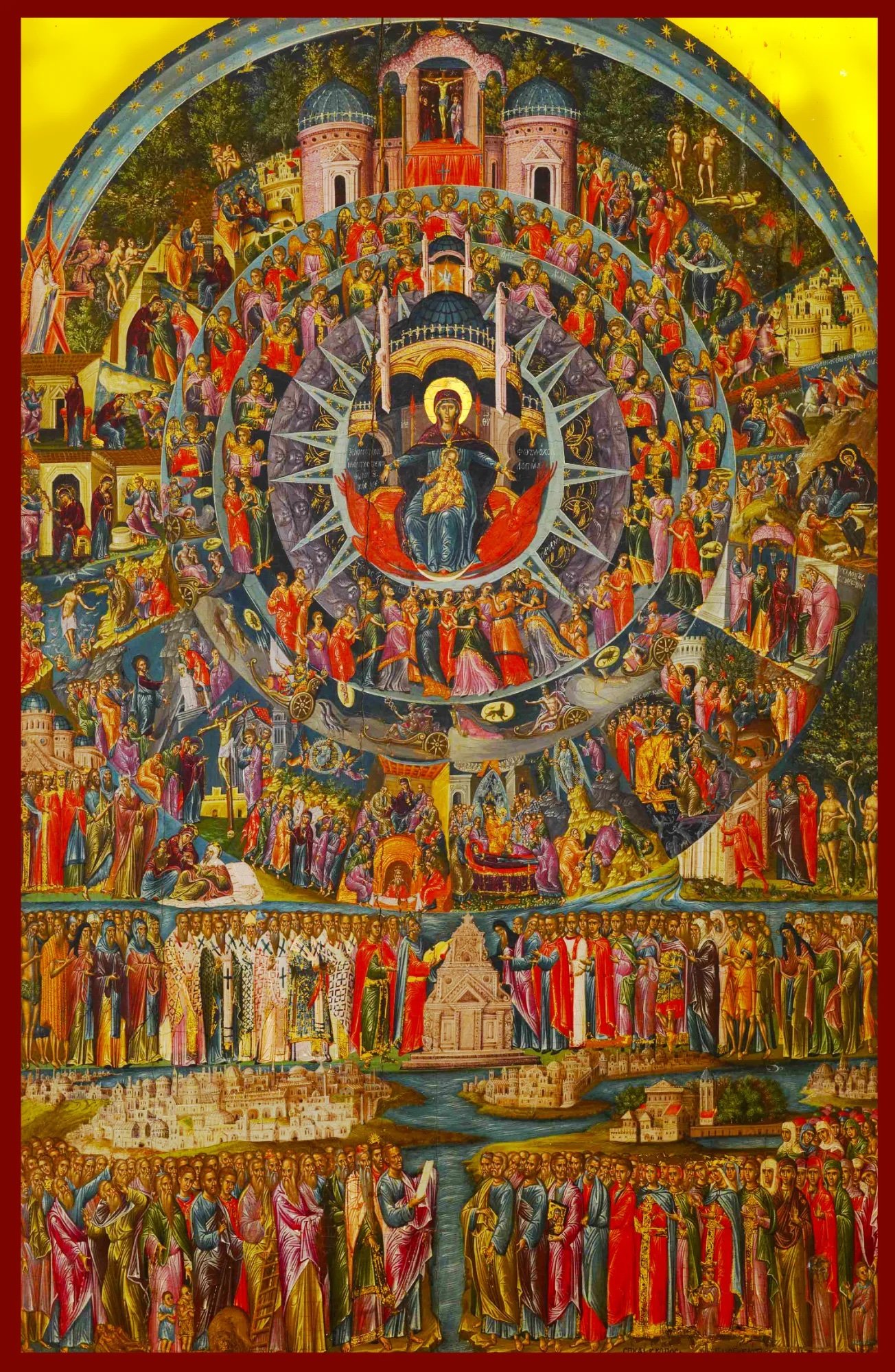

Left: "In Thee Rejoiceth" (Hymn to the Theotokos) — Right: Detail showing celestial paradise
"In Thee Rejoiceth" (Hymn to the Theotokos)
Ἐπὶ σοὶ χαίρειAn extraordinarily complex icon type depicting the entire created order — angels, prophets, saints, and all humanity — gathered around the enthroned Theotokos and Christ. Based on a hymn sung during the Divine Liturgy.
Elements include:
- Central enthroned Theotokos with Christ
- Concentric circles of angels
- Paradise garden and the heavenly Jerusalem
- Prophets with scrolls foretelling the Incarnation
- Choirs of saints by category (martyrs, hierarchs, monastics)
- Architectural representations of churches
These masterwork compositions can contain 100+ individual figures and require 8-14 months to complete.
Theotokos with Prophets
The central Theotokos (often Platytera or enthroned) is surrounded by Old Testament prophets holding scrolls with texts foretelling the Incarnation or symbols of Mary's virginity:
- Isaiah — "Behold, a virgin shall conceive"
- Ezekiel — The closed gate
- Moses — The burning bush
- Daniel — The mountain from which the stone was cut
- Gideon — The fleece
- Jacob — The ladder to heaven
Symbolism in Theotokos Icons
Mary's Garments
| Element | Color | Meaning |
|---|---|---|
| Maphorion (veil) | Dark blue or purple | Heavenly royalty, humanity |
| Inner garment | Blue or red | Divinity, divine grace |
| Three stars | Gold | Virginity before, during, and after birth |
| Gold cuffs/trim | Gold | Royal status, divine glory |
Christ's Appearance
In Theotokos icons, Christ typically appears as Emmanuel — a small but mature figure (not a baby) with adult proportions and facial features. This emphasizes His divine wisdom and eternal existence.
Inscriptions
- MP ΘΥ — Μήτηρ Θεοῦ (Mother of God)
- IC XC — Jesus Christ
- Ο ΩΝ — "The One Who Is" (in Christ's halo)
Choosing a Theotokos Icon
For Home Prayer Corners
- Hodegetria — Teaching, directing to Christ
- Eleousa — Tender, emotional, comforting
- Vladimir or Kazan — Popular, widely available
For Churches
- Platytera — Traditional for the apse
- Enthroned Theotokos — Iconostasis central icon
- Hodegetria — Teaching and catechetical emphasis
For Special Intentions
- Joy of All Who Sorrow — For those in distress
- Unexpected Joy — For those seeking consolation
- Quick to Hear — For urgent prayers
- Inexhaustible Cup — For those struggling with addiction
Commissioning Theotokos Icons
| Type | Complexity | Timeline | Price Range |
|---|---|---|---|
| Standard Hodegetria/Eleousa | 2 figures | 3-4 months | €2,500 - €5,000 |
| Theotokos with Prophets | 10-15 figures | 5-7 months | €5,000 - €10,000 |
| "In Thee Rejoiceth" | 100+ figures | 10-14 months | €12,000 - €25,000 |
Commission Your Theotokos Icon
We specialize in complex Theotokos compositions including "In Thee Rejoiceth," Theotokos with Prophets, and rare regional types. Each masterwork is researched from historical prototypes and created using traditional techniques.
Request a Consultation