A complete guide to understanding the Last Judgment icon — the most complex composition in Byzantine iconography, depicting Christ's return, the resurrection of the dead, and the final separation of the righteous and the damned.

The Second Coming icon in the Klontzas style — note the multiple registers and hundreds of figures
Introduction
The Second Coming (Greek: Δευτέρα Παρουσία, Deutera Parousia), also known as the Last Judgment, is considered the most theologically rich and artistically complex icon in the entire Byzantine tradition. These monumental compositions can contain over 300 individual figures arranged in multiple registers, depicting the culmination of human history according to Orthodox Christian belief.
Whether you've encountered this icon in an Orthodox church, a museum, or are considering commissioning one, understanding its intricate symbolism unlocks a profound visual theology that has inspired believers for over a millennium.
What Does the Second Coming Icon Depict?
The Second Coming icon illustrates the events described in Matthew 25, Revelation 20-21, and other biblical passages about Christ's return at the end of time. It shows:
- Christ's glorious return as Judge of the living and the dead
- The resurrection of all who have ever lived
- The final judgment where deeds are weighed
- The separation of the righteous (Paradise) from the unrighteous (Hell)
- The defeat of Satan, death, and evil
Unlike single-moment icons, the Second Coming is a composite narrative — showing multiple events simultaneously in a cosmic theological landscape.
The Structure of the Second Coming Icon
Traditional Second Coming icons are organized in horizontal registers (bands) read from top to bottom, representing the descent from heaven to earth to the underworld.
Upper Register: The Heavenly Realm
Christ in Glory (Central Figure)
At the apex sits Christ Enthroned, depicted in a mandorla (almond-shaped glory) of divine light. Key elements include:
- The Judge's Throne — Christ sits on a rainbow or golden throne
- The Open Book — Containing the words "Come, you blessed of my Father" and "Depart from me, you cursed"
- Gesture of Judgment — Right hand raised in blessing, left hand lowered
- White Garments — Symbolizing purity and divine glory
The Theotokos and John the Baptist
Flanking Christ are the Deisis (supplication) figures:
- The Theotokos (Virgin Mary) — Interceding for humanity on Christ's right
- St. John the Baptist — The Forerunner, on Christ's left
Both are shown slightly bowed, with hands extended in prayer for mercy on mankind.
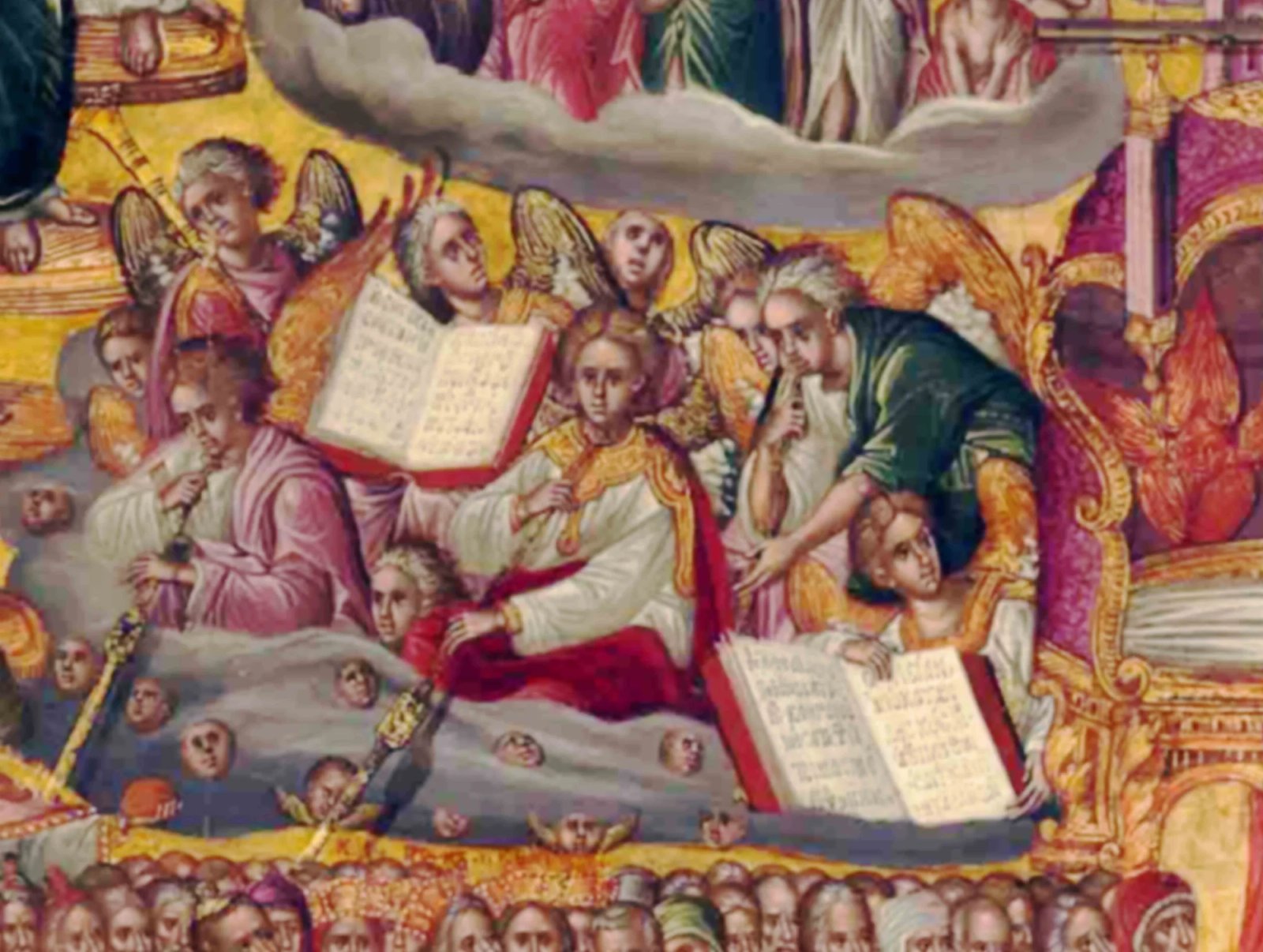
Detail: Angels with golden wings and open books, serving as celestial scribes
Middle Registers: Judgment and Resurrection
The Hetoimasia (Prepared Throne)
Below Christ appears the Hetoimasia — an empty throne prepared for judgment, displaying:
- The Cross — Instrument of salvation
- The Lance and Sponge — Passion implements
- Adam and Eve — Kneeling in prostration, representing redeemed humanity
- The Book of Life — Open, with names of the saved

Detail: Holy hierarchs in polystavrion vestments with multiple crosses
The Apostles as Co-Judges
The Twelve Apostles sit on thrones, fulfilling Christ's promise: "You will sit on twelve thrones, judging the twelve tribes of Israel" (Matthew 19:28).
The Weighing of Souls
A dramatic scene shows the Psychostasia (soul-weighing):
- An angel holds scales weighing good deeds against sins
- Demons attempt to tip the scales toward condemnation
- A scroll unrolls listing the person's deeds
The Resurrection of the Dead
The earth and sea give up their dead:
- Graves open — Bodies reassemble from bones
- The sea returns its dead — Fish and sea creatures release human forms
- Wild beasts — Lions, wolves, and birds return consumed flesh
- Angels with trumpets — Calling all to rise
Lower Registers: Paradise and Damnation
The River of Fire
A river of fire flows from beneath Christ's throne, descending to Hell. This represents divine judgment proceeding from God, the purifying and punishing nature of God's presence, and the definitive separation of good and evil.
Paradise (Right Side)
The righteous proceed through the gates of Paradise:
- St. Peter — Holding keys, welcoming the saved
- The Good Thief — First to enter Paradise, holding his cross
- Abraham's Bosom — The patriarch holding souls of the righteous
- The Garden of Eden — Trees, flowers, the Tree of Life
- Choirs of saints — Martyrs, prophets, hierarchs in white robes
Hell (Left Side)
The damned descend into Gehenna:
- Satan/Hades — A dark figure bound in chains, sometimes seated on a beast
- The Rich Man — From the parable of Lazarus, in flames
- Specific torments — Different punishments for different sins
- Demons — Tormenting the condemned
- Darkness and fire — Contrasting with Paradise's light

Detail: Angel battling demons above the river of fire and the architecture of Hades
Key Symbolic Elements Explained
The Mandorla
The almond-shaped light surrounding Christ represents divine, uncreated light (distinct from physical light), Christ's two natures (divine and human) united, and the boundary between created and uncreated realms.
Colors in the Second Coming Icon
| Color | Symbolic Meaning |
|---|---|
| Gold | Divine presence, uncreated light, eternity |
| Blue | Heaven, divinity, mystery |
| Red | Divine energy, martyrdom, Christ's humanity |
| White | Purity, resurrection, the redeemed |
| Green | Life, renewal, the Holy Spirit |
| Black | Death, evil, the underworld |
The Serpent
A serpent often winds through the composition from Satan's throne to Adam's heel, representing the continuity of sin from the Fall to Judgment, the ancient prophecy fulfilled (Genesis 3:15), and death's reign from Adam to Christ.
Regional Variations
Byzantine/Greek Style
- Warm colors (ochres, reds, gold)
- More figures, intricate detail
- Strong gold backgrounds
- Elegant, flowing compositions
Cretan School
- Combines Byzantine tradition with Italian influence
- Rich, vibrant colors
- Highly detailed miniature scenes
- Masters include Theophanes the Cretan, Georgios Klontzas
Commissioning a Second Coming Icon
Due to its complexity, the Second Coming is among the most challenging icons to create and commission.
What to Consider:
Size Requirements
- Minimum recommended: 60×80cm for readable detail
- Ideal for full complexity: 80×100cm or larger
- Church installations: 150×200cm or more
Timeline
- Simplified compositions: 8-10 months
- Full masterwork: 12-18 months
Cost Range
- Simplified compositions: €8,000 - €15,000
- Full masterwork: €15,000 - €40,000+
- Church-scale installations: €40,000+
The Theology Behind the Icon
Orthodox Understanding of Judgment
The icon presents several key theological points:
- Universal Resurrection — All will be raised, not just the righteous
- Personal Accountability — Each person answers for their own deeds
- Divine Justice and Mercy — Both attributes fully expressed
- Definitive Separation — The age of repentance ends
- Christ as Judge — The same Christ who died for humanity now judges it
Not Fear, But Hope
While Hell is depicted graphically, the icon's purpose is not primarily to frighten but to encourage repentance while time remains, celebrate the ultimate triumph of good over evil, affirm that suffering and injustice are temporary, and inspire hope in resurrection and eternal life.
Commission a Second Coming Masterwork
We specialize in complex multi-figure compositions including the Second Coming, with over 20 years of experience creating museum-quality icons. Each masterwork contains 200-300+ individual figures with extraordinary detail.
Request a Consultation